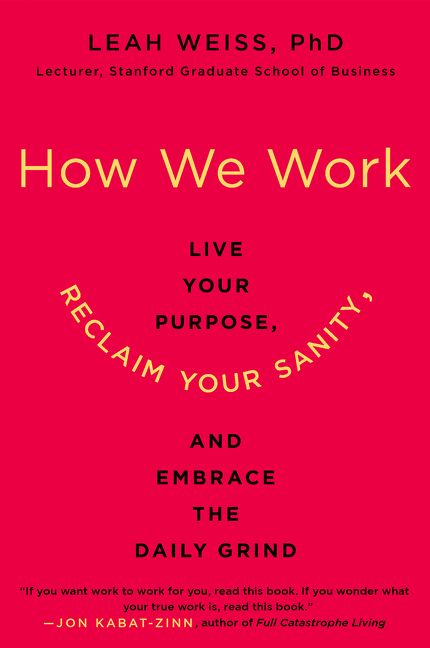
How We Work: Live Your Purpose, Reclaim Your Sanity, and Embrace the Daily Grind
A practical guide to thriving at work, based on a popular course offered at the Stanford Graduate School of Business.“If you want work to work for you, read this book. If you wonder what your true work is, read this book.”—Jon Kabat-Zinn, author of Full Catastrophe Living and Coming to Our Senses
In today’s workplace, the traditional boundaries between “work” and “personal” are neither realistic nor relevant. Office hours bleed into evenings and weekends; e-mails and calls can be fielded from home; and the stresses of life—young kids, aging parents, financial hardships— don’t evaporate when we walk into the office on Monday morning.The truth is, we don’t show up to work as a portion of ourselves—by necessity, we bring our whole selves to everything we do. In How We Work, mindfulness expert Dr. Leah Weiss, creator of the perennially wait-listed Stanford Graduate School of Business course Leading with Mindfulness and Compassion, explains why the false “work-life” dichotomy may be destructive to both our mental health and our professional success. The bad news is that nothing provides more opportunities for uncomfortable emotions—anxiety, fear, anger, and paranoia, to name a few—than the workplace. The good news is that these feelings are not liabilities but assets. Our emotions at and about work matter—to us, to the quality of our work, and ultimately to the success of the organizations for which we work.The path to productivity and success, says Weiss, is not to change jobs, to compartmentalize feelings, or to create a false “professional” veneer—but rather to pay attention to how we feel. Using mindfulness techniques, we can become aware of and attend to difficult emotions without becoming consumed by them, and identify the values and goals that allow us to find meaning in even the most menial tasks. In How We Work, Weiss offers evidence-based strategies for practicing mindfulness in the real world, showing us not only how to survive the daily grind but how to embrace it.
A practical guide to thriving at work, based on a popular course offered at the Stanford Graduate School of Business.“If you want work to work for you, read this book. If you wonder what your true work is, read this book.”—Jon Kabat-Zinn, author of Full Catastrophe Living and Coming to Our Senses
In today’s workplace, the traditional boundaries between “work” and “personal” are neither realistic nor relevant. Office hours bleed into evenings and weekends; e-mails and calls can be fielded from home; and the stresses of life—young kids, aging parents, financial hardships— don’t evaporate when we walk into the office on Monday morning.The truth is, we don’t show up to work as a portion of ourselves—by necessity, we bring our whole selves to everything we do. In How We Work, mindfulness expert Dr. Leah Weiss, creator of the perennially wait-listed Stanford Graduate School of Business course Leading with Mindfulness and Compassion, explains why the false “work-life” dichotomy may be destructive to both our mental health and our professional success. The bad news is that nothing provides more opportunities for uncomfortable emotions—anxiety, fear, anger, and paranoia, to name a few—than the workplace. The good news is that these feelings are not liabilities but assets. Our emotions at and about work matter—to us, to the quality of our work, and ultimately to the success of the organizations for which we work.The path to productivity and success, says Weiss, is not to change jobs, to compartmentalize feelings, or to create a false “professional” veneer—but rather to pay attention to how we feel. Using mindfulness techniques, we can become aware of and attend to difficult emotions without becoming consumed by them, and identify the values and goals that allow us to find meaning in even the most menial tasks. In How We Work, Weiss offers evidence-based strategies for practicing mindfulness in the real world, showing us not only how to survive the daily grind but how to embrace it.
Original: $13.39
-65%$13.39
$4.69Description
A practical guide to thriving at work, based on a popular course offered at the Stanford Graduate School of Business.“If you want work to work for you, read this book. If you wonder what your true work is, read this book.”—Jon Kabat-Zinn, author of Full Catastrophe Living and Coming to Our Senses
In today’s workplace, the traditional boundaries between “work” and “personal” are neither realistic nor relevant. Office hours bleed into evenings and weekends; e-mails and calls can be fielded from home; and the stresses of life—young kids, aging parents, financial hardships— don’t evaporate when we walk into the office on Monday morning.The truth is, we don’t show up to work as a portion of ourselves—by necessity, we bring our whole selves to everything we do. In How We Work, mindfulness expert Dr. Leah Weiss, creator of the perennially wait-listed Stanford Graduate School of Business course Leading with Mindfulness and Compassion, explains why the false “work-life” dichotomy may be destructive to both our mental health and our professional success. The bad news is that nothing provides more opportunities for uncomfortable emotions—anxiety, fear, anger, and paranoia, to name a few—than the workplace. The good news is that these feelings are not liabilities but assets. Our emotions at and about work matter—to us, to the quality of our work, and ultimately to the success of the organizations for which we work.The path to productivity and success, says Weiss, is not to change jobs, to compartmentalize feelings, or to create a false “professional” veneer—but rather to pay attention to how we feel. Using mindfulness techniques, we can become aware of and attend to difficult emotions without becoming consumed by them, and identify the values and goals that allow us to find meaning in even the most menial tasks. In How We Work, Weiss offers evidence-based strategies for practicing mindfulness in the real world, showing us not only how to survive the daily grind but how to embrace it.